Documents before scope
- Scope is proposed only after the documents in force have been read.
- Fees follow the reading, never precede it.
MASAR Business Legal Advisors is a business-focused law firm advising companies on matters that affect revenue, operations and commercial risk — from contracts, credit and projects to negotiation, disputes and enforcement.

The firm is led by a practising lawyer active since 2012, with hands-on experience in negotiation, civil and commercial disputes, and matters that require several legal and commercial tracks to move at the same time.
That experience shapes how MASAR approaches disputes: negotiation is not treated as weakness, and litigation is not treated as the first proof of strength. Each route is used when it serves the client’s commercial objective and protects its legal position.


Before choosing a procedure, we usually need four answers: what does the company need to preserve, what can be proved now, where does real leverage sit, and what will any proposed step do commercially? Those questions determine the management of the file more than the name of the legal procedure. Sometimes the documents need to be rebuilt before negotiation; sometimes the answer is a secured settlement; sometimes immediate action is needed to preserve the right.
We try to give every matter one clear picture: facts, documents, amounts, parties, prior decisions, deadlines and weaknesses before strengths.
That makes negotiation more serious and, where escalation becomes necessary, ensures it is based on a built file rather than a reaction. It also allows the decision-maker inside the company to understand why we recommend a step, what it costs and what the alternative is if it fails.


We read the signed terms together with conduct, correspondence, approvals, payments and performance.
We ask whether the right can be proved, enforced and recovered, and at what cost.
We compare time, money, relationships, assets and enforceability.
Negotiation is a tool for protecting leverage and achieving a defined result, not for postponing the problem.
The commitments that do not change from one engagement to the next.
We focus on sectors whose commercial mechanics and legal risks we can understand, rather than presenting an unlimited list of legal services.
For us, industry knowledge is not a website label. It is part of the quality of the legal advice.
Every engagement ends with a document naming what is sound, what is exposed, and what to correct first.
Cost is set against a body of work agreed before it begins, not against time spent.
Arabic and English are each drafted in their own language, so nothing is lost carrying one into the other.
What we write is built to hold through funding rounds, new jurisdictions and a change of shareholder.
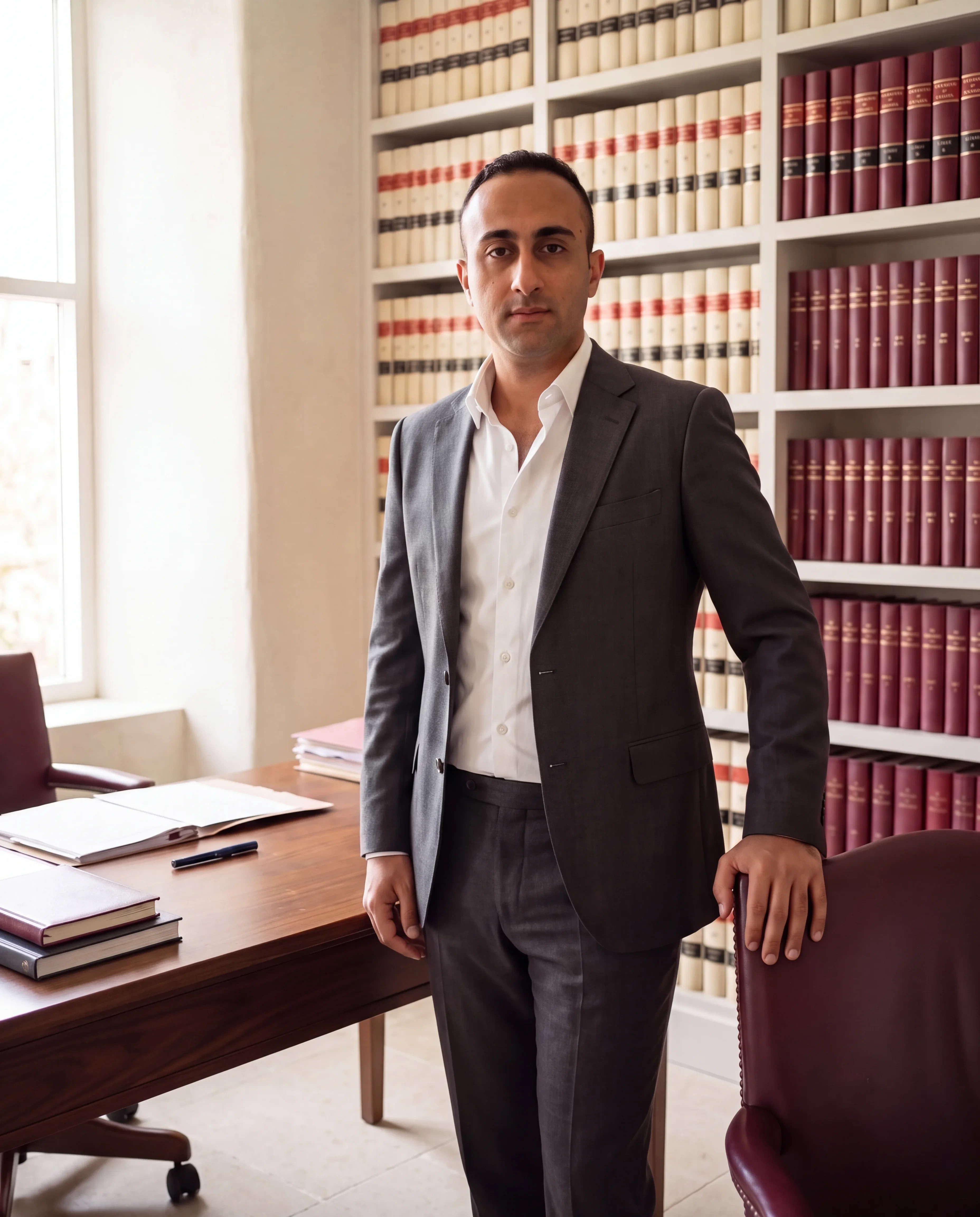
His approach is built on a simple principle: a dispute does not eliminate the value of negotiation, and negotiation does not require surrendering legal strength. In many matters, the lawyer’s role is to preserve the client’s ability to choose between several routes, rather than arriving late when only one route remains.
Ahmed has practised law since 2012, with increasing focus on business-related disputes, transactions, negotiation and legal risk management.